Temperature is one of the operating conditions that can be easy to miss when choosing or using a flow meter for petroleum products. A meter may be installed correctly and calibrated properly, but the reading can still change as the temperature of the liquid goes up or down.
The reason is not especially complicated. Petroleum products do not keep exactly the same physical properties at every temperature. Their density, viscosity, volume, and pressure can change as they warm or cool. The measurement principle used by the meter also affects how much those changes influence the final result.
For fuel distributors, oil terminals, tank farms, transport companies, process plants, and equipment manufacturers, this can become a real measurement issue. A small difference may look insignificant on one delivery, but when thousands of liters or barrels are transferred every day, the difference can add up.
A Petroleum Flow Meter should therefore be selected and operated with the actual temperature range of the fluid in mind.
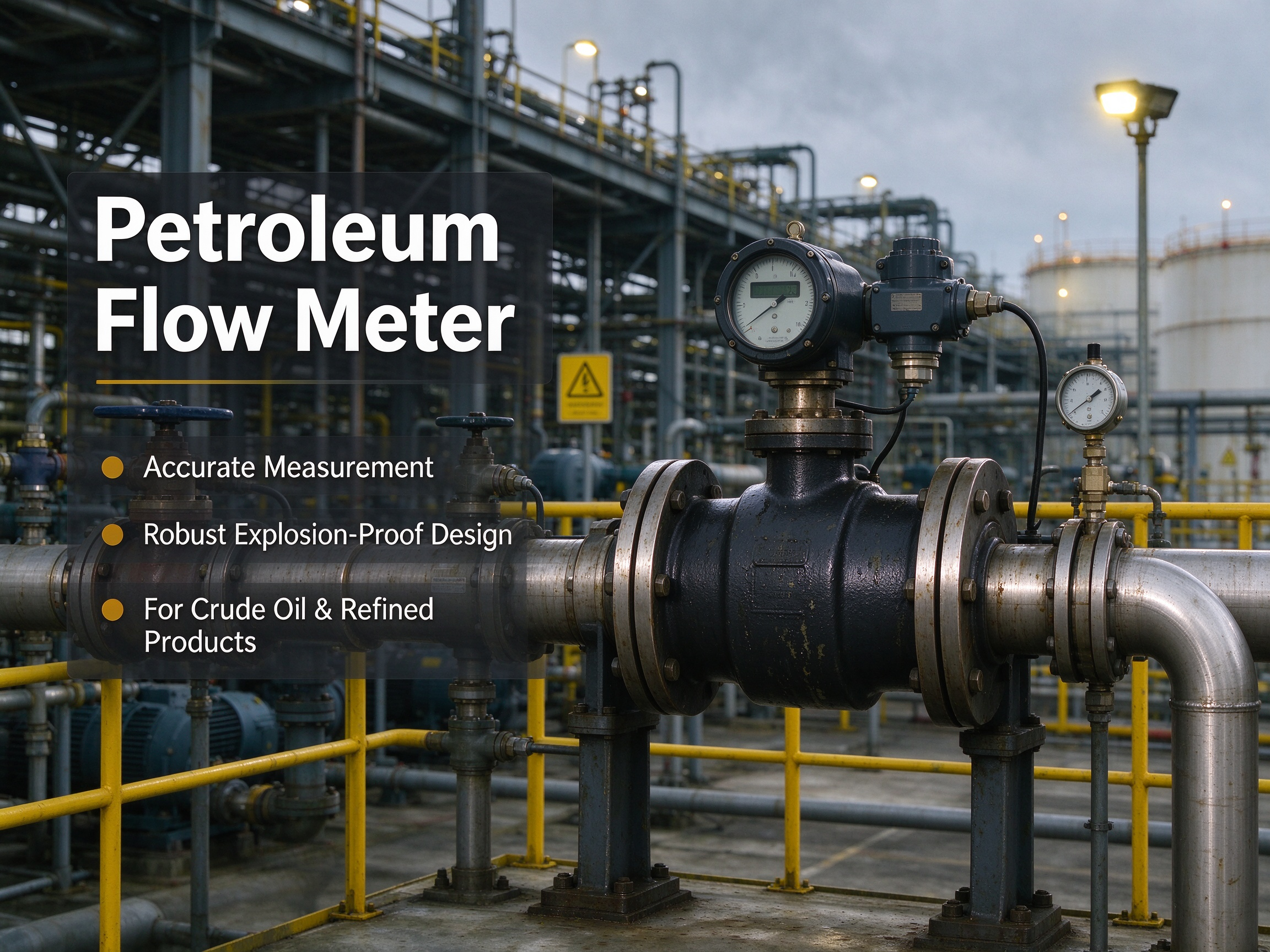
Petroleum products can gain or lose heat at several stages during storage and transfer.
A fuel sitting in an outdoor tank may become warmer during the day and cool again overnight. The product can also change temperature while moving through pumps, pipelines, loading arms, or processing equipment.
Temperature changes may come from:
So even when the meter itself is installed in a fairly stable environment, the liquid entering it may have a different temperature from the product in the storage tank.
This matters because the same amount of petroleum can occupy different volumes at different temperatures.
Most petroleum liquids expand when heated and contract when cooled.
Imagine a storage tank containing a fixed quantity of fuel. As the temperature rises, the liquid generally takes up more space. When the temperature falls, it occupies less space.
This creates a difference between the volume measured at the actual flowing temperature and the volume adjusted to a defined reference temperature.
For commercial petroleum measurement, that reference condition can be quite important. Two deliveries may contain the same mass of product but show different raw volumes simply because they were measured at different temperatures.
A flow meter may measure the actual volume passing through the line, while the final quantity may need to be corrected to a standard reference condition according to the applicable measurement method.
Temperature doesn't only change volume. It also affects density.
As petroleum becomes warmer, its density generally decreases because the same mass takes up more space. When the liquid cools, its density generally increases.
This is important when a process or transaction is based on mass.
The basic relationship is:
Mass = Density × Volume
If a system uses measured volume to calculate mass, the density value needs to reflect the actual fluid condition. When the temperature changes but the calculation continues using one fixed density value, the calculated mass may not be accurate.
For this reason, some petroleum measurement systems use temperature compensation together with density information.
Temperature also changes viscosity, which describes how strongly a liquid resists flowing.
Many petroleum products become less viscous as they warm up. Cooler fluids can behave differently as they pass through pipes, valves, and meters, which may change pressure loss and the way certain meter components operate.
The effect depends on the meter technology.
For example, positive displacement meters measure liquid through defined internal volumes and can work well with viscous products. However, viscosity changes can still influence internal friction and leakage.
| Temperature effect | Potential measurement impact |
|---|---|
| Volume expands | Volume reading changes |
| Density decreases | Mass calculation may change |
| Viscosity decreases | Pressure loss and meter behavior can change |
| Pressure changes | Can affect some measurement systems |
| Fluid properties shift | Calibration conditions may no longer match actual operation |
The actual effect depends on the petroleum product, meter construction, and operating conditions.
“Petroleum” is a broad category. Gasoline, diesel, kerosene, lubricating oils, crude oil, and other hydrocarbon products do not all respond to temperature in exactly the same way.
A light fuel may show different viscosity behavior from a heavier oil. Crude oil can be even more variable because its composition and flow characteristics depend on its source and grade.
That means temperature compensation should be based on the actual product being measured, not simply the fact that it is a petroleum product.
For B2B buyers, useful information includes:
A meter selected for one petroleum product should not automatically be assumed suitable for every other hydrocarbon liquid.
Positive displacement meters measure a defined quantity of liquid as internal measuring elements rotate or move.
This measuring principle is used in many liquid applications, but temperature can still influence the way the meter performs.
At lower temperatures, a more viscous petroleum product may create greater mechanical resistance. As the product warms and becomes thinner, internal leakage characteristics can change depending on the meter's clearances and design.
Temperature can also produce small dimensional changes in the meter's internal components.
For a Petroleum Flow Meter based on positive displacement technology, buyers should review the specified temperature and viscosity ranges instead of looking only at the flow capacity.
Coriolis flow meters determine mass flow from the behavior of fluid moving through vibrating tubes. Many models can also provide density information.
This can be useful in petroleum applications where mass measurement or density data is important.
Temperature still needs to be considered, though. The physical properties of the petroleum change as temperature changes, while the sensor tubes, electronics, and other parts of the meter also have specified operating ranges.
A suitable system can use compensation and calibration methods to keep measurement performance within the required range.
So temperature isn't necessarily a problem for Coriolis measurement. It is simply one of the conditions that needs to be included in the system design.
Turbine flow meters use a rotor that turns as liquid passes through the meter.
The relationship between rotor speed and fluid velocity depends on the meter's design and calibration.
As temperature changes, viscosity changes as well. That can affect rotor movement, internal friction, and the conditions inside the measuring section.
This does not mean turbine meters are unsuitable for petroleum systems where temperature varies. The main point is to keep the meter within its specified operating range and use calibration information that matches the actual application.
For higher-value petroleum transfers, testing the complete measurement setup under realistic temperature and flow conditions can provide useful information.
The petroleum isn't the only thing responding to temperature.
Meter bodies, shafts, seals, measuring chambers, connected pipes, and other components can expand or contract as their temperature changes.
These dimensional changes may be very small, but tighter measurement requirements can make them worth considering.
Material selection therefore has a role in thermal behavior. Depending on the application, manufacturers may use stainless steel, carbon steel, aluminum, specialized polymers, or other materials.
The practical question is whether the complete meter assembly maintains its intended mechanical characteristics throughout the specified temperature range.
A petroleum transfer system doesn't always have one uniform temperature from beginning to end.
A product could leave a warm storage tank, move through a cooler pipeline, and then enter a meter installed in a different ambient environment.
As a result, the liquid temperature at the meter may not be the same as the temperature recorded at the tank. It may also continue to change during the transfer.
This creates a practical question: which temperature should be used for compensation?
The answer depends on the defined measurement point and how the quantity is being reported.
Temperature sensor placement matters too. A sensor installed too far upstream or downstream may not accurately represent the liquid temperature at the actual measuring point.
When temperature compensation is part of the measurement process, the temperature sensor becomes another important part of the accuracy chain.
It should match the required temperature range and provide a suitable response time, installation method, and accuracy.
A sensor that reacts too slowly may miss rapid temperature changes during loading. Poor placement can also result in a reading that does not represent the actual fluid condition.
A complete measurement setup may include:
The exact combination depends on what the system needs to measure.
In many petroleum transactions, volume needs to be reported at a defined reference temperature.
Physical volume changes with temperature, so using a common reference makes quantities easier to compare.
The actual reference temperature and correction method depend on the contract, applicable standards, jurisdiction, and industry practice.
For B2B buyers, the measurement basis should be established before the meter is installed.
Questions may include:
Without clear answers, two parties may report different quantities from the same physical transfer even though the equipment is operating normally.
Temperature compensation uses measured temperature information to adjust the reported quantity according to the chosen measurement basis.
A simplified example is:
Corrected Volume = Measured Volume × Temperature Correction Factor
The actual correction factor is not the same for every petroleum product. Different products have different thermal expansion characteristics, so the system needs suitable property data and an appropriate calculation method.
For large-volume operations, this can help keep loading records, receiving records, storage data, and inventory calculations more consistent.
Ignoring temperature may not create a major issue in a simple process where the temperature range is narrow and the required measurement accuracy is fairly modest.
The situation changes when the fluid temperature varies considerably.
Possible consequences include:
The impact becomes easier to see as transfer volume increases. A small difference on one line may have limited financial effect, but the same difference across a large petroleum transfer can become significant.
A flow meter is designed to work within defined operating conditions, and its calibration is based on particular test conditions.
Depending on the technology and application, factory testing may involve selected flow rates, pressures, fluid viscosities, and temperatures.
B2B buyers should check the conditions under which the meter's stated performance was verified.
| Quality factor | Why it matters |
|---|---|
| Flow calibration | Confirms meter response at defined flow rates |
| Temperature range | Verifies suitable operating conditions |
| Pressure range | Helps prevent operation beyond design limits |
| Material compatibility | Supports long-term fluid handling |
| Sensor calibration | Improves compensation accuracy |
| Repeatability testing | Checks consistency between measurements |
| Traceable records | Supports quality and maintenance programs |
For critical custody-transfer applications, additional verification may be required according to the relevant metrology requirements.
Before placing an order, buyers should provide actual process information rather than only giving the pipe size or desired flow rate.
Useful details include:
Buyers can also ask:
These questions make it easier to judge whether the selected meter really fits the application.
Laboratory specifications are useful, but field conditions are often a little messier.
For a new petroleum transfer system, buyers can compare meter performance at representative temperatures and flow rates. The data collected during commissioning can then provide a reference for later maintenance and verification.
For example, a terminal may operate through both hot summer conditions and much cooler winter conditions. Testing under only one temperature may not show how the complete measurement system behaves throughout the year.
Where temperature changes are significant, periodic or seasonal checks can provide a clearer picture of long-term consistency.
A flow meter manufacturer can support temperature-sensitive applications by selecting suitable meter technology, materials, sensors, compensation functions, and calibration procedures.
Depending on the project, customization may include the meter body, connection size, pressure rating, temperature sensor integration, display configuration, communication protocol, or flow computer.
For OEM applications, providing a process diagram can also help the manufacturer understand the measurement point, upstream and downstream conditions, and the location where temperature needs to be measured.
This is particularly useful when flow measurement is connected to inventory control, billing, or commercial transfer.
Temperature changes can affect Petroleum Flow Meter readings because they change petroleum volume, density, viscosity, and other physical properties. Temperature can also influence the dimensions and operating behavior of the meter itself.
In a relatively simple system where the temperature range is small, the effect may be limited. In bulk petroleum transfer, though, temperature correction and clearly defined measurement conditions can become much more important.
For B2B buyers, the practical starting point is the actual petroleum product, operating temperature range, flow conditions, and measurement basis. From there, the appropriate meter technology and compensation method can be selected. Factory calibration, accurate temperature sensing, and testing under realistic operating conditions can help maintain more consistent measurement results as the product temperature changes.
Quick Links
Product Categories
Contact Us
+86-13695828855
+86-15988773632 -abner lee
+86-13989700818 -Friendship Ge
No. 3, Xinbin Road, Yangwan Industrial Zone, Qiaoxia Town, Yongjia County, Wenzhou City, Zhejiang Province
Get in Touch
 Oil & Gas Refueling Equipment
 English
 中文简体
中文简体
 Español